Drew Black’s Death and Forged Confession Letter
Match PointDrew Black’s death becomes the apparent solution to the campaign of threats against Willa Ashford, then its most consequential deception. Found hanging in his apartment, Drew seems to have left a confession explaining the attacks and other killings; the revelation that Corey Baxter killed him and fabricated the letter turns that apparent answer into evidence of a wider effort to misdirect blame.
Threats and the apparent trail to Drew
Before Drew’s body is found, Willa’s return to volleyball is accompanied by escalating threats. A mailed note warns that she must withdraw from the tournament or die like her partner, Colleen Sherman. Later, after Willa overlooks a string of increasingly frantic messages from Corey, an altered voice on a voicemail warns her to quit or face consequences. The caller ID displays the name Hazel Reyno, but the voice gives Willa no way to identify its speaker. The messages create a trail of clues without yet establishing who is behind them.
The danger also becomes physical. At the beach house where Willa is staying, Colt Fontaine finds someone testing the front doorknob and peering through the windows. Later, an alarm alerts Colt, Anja Johansen, and Luca Russo to a person climbing over the wall around the private volleyball court. Colt has already judged the rental house’s existing cameras insufficient and planned to cover its entrances and perimeter more thoroughly. These incursions make the threat feel immediate, but they do not prove that Drew is responsible. That distinction matters once a confession appears to settle the question.
Discovery and the apparent confession
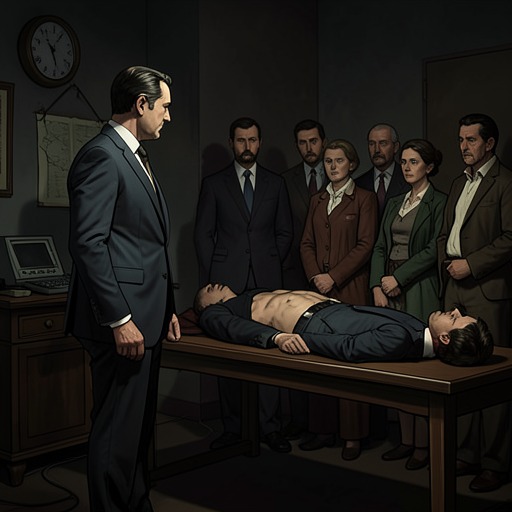
The news reaches Willa through Corey, who calls to check that she is alive and tells her that Drew is dead. He says Drew has left a note confessing to killing Willa, a claim that initially makes the death seem connected to the danger surrounding her. Colt goes with Willa to Drew’s apartment, where police are present and Corey waits in shock. An officer reports finding a man of approximately thirty-five hanging from a ceiling beam. The scene is treated as a suicide, and the investigation now has a document that seems to explain both Drew’s death and the attempted murder.
The officer shows Colt an image of the typed letter. Written in Drew’s name, it presents a remorseful account: Drew says he sent notes to stop Willa competing, tried to deter her by blowing up his truck, and eventually shot at her, though he claims he did not mean to kill her. It also attributes other deaths to him, including people who caught him in the act and a woman in Valley Center. The letter calls its writer a serial killer and frames the deaths as the consequence of guilt, panic, and misguided attempts to protect Colleen’s memory.
Its most intimate allegation gives the supposed violence a motive. The letter claims Drew had been in love with Colleen and having an affair with her, and that he feared Willa’s success with a new partner would cause Colleen’s accomplishments to be forgotten. It further claims Colleen had planned to tell Corey about the affair on the day she died. The document therefore seems to transform a series of threats into a warped act of remembrance: in its account, Drew tried to preserve Colleen’s legacy by preventing Willa from moving forward. But the letter is not reliable testimony. Its detail and apparent remorse give a false account the shape of a confession, not proof of its authorship or truth.
The false confession is exposed
The decisive reversal comes when Willa accuses Corey of killing Drew and framing him with the confession. Corey’s response confirms the central charge: he says Drew had discovered a picture sent by Oskar Latu, understood what it implied, and was going to tell Willa. Corey says he feared Colleen would then be killed. The earlier apparent suicide is thus recast as a killing concealed by a staged-seeming scene and a forged document; the evidence here establishes that Corey killed Drew, though it does not specify how.
Corey also explains how the false confession served his own purpose. He says he did not want Willa to compete because he believed her return would betray Colleen’s memory, and insists that his attempts to warn her away were meant to protect Colleen and secure her freedom. He acknowledges trying to make Willa quit, says he used a rifle, and recalls being surprised when she answered her phone after he thought he had shot her. He also describes setting the house on fire as a last attempt to reach her. These admissions make the supposed confession’s account of a single, guilt-ridden perpetrator impossible to accept at face value: Corey was pursuing his own campaign while the letter placed the blame on Drew.
Consequences and narrative significance
The forgery exploits relationships that could make its story persuasive. Drew and Corey had been beach-volleyball partners and close friends; Corey’s distress at Willa’s survival and his presence at Drew’s apartment initially lend him the appearance of someone caught in a personal tragedy. The letter’s claim that Drew loved Colleen also turns grief and loyalty into a plausible explanation for violence. Yet Corey’s professed devotion is inseparable from control: he treats Willa’s choice to compete as something he can override, then casts the harm caused by his efforts as her fault for refusing to stop.
Drew’s death therefore does not close the investigation; it reveals how thoroughly its evidence has been manipulated. The typed confession redirects suspicion toward a dead man and gives Corey a false account with which to bury his own actions. When Willa identifies the letter as his and Corey explains why Drew had to be silenced, the supposed final confession becomes the instrument of a cover-up. The event’s central reversal is not simply that Drew did not confess: it is that the man who appeared to bring Willa news of the danger had used Drew’s death to disguise his own role in it.